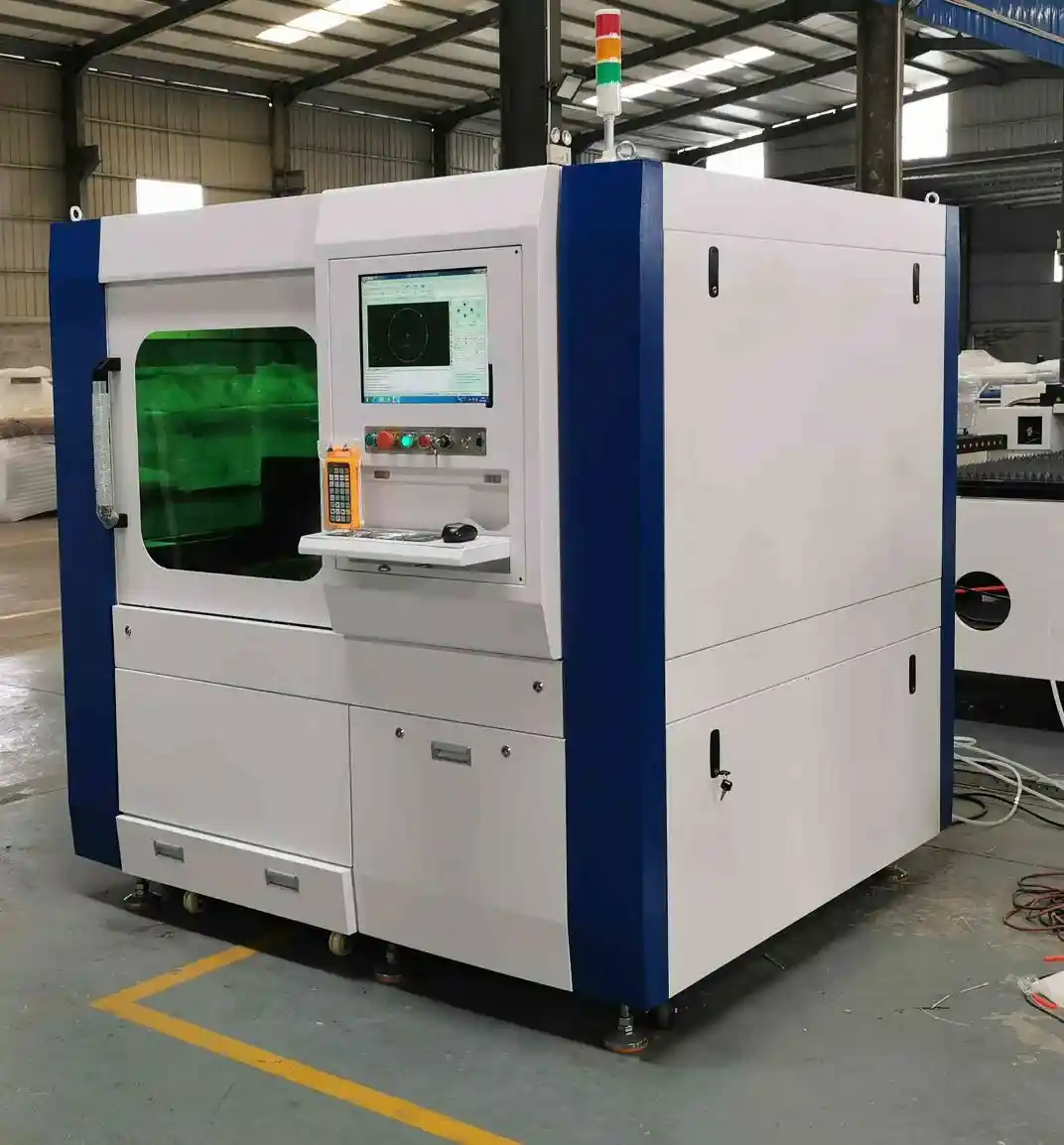
A machine arriving on a truck is the middle of the process, not the end of it -- site preparation before delivery and proper commissioning after it both affect how quickly a new fiber laser cutting machine actually gets to full production, and safety isn't a separate topic from either one.

GF Series Large-Format Gantry Fiber Laser Cutting Machine -- large-format machines like this one need the most site-prep planning before delivery.
Site Preparation Before the Machine Arrives
- Power service. Confirm your facility's voltage and available capacity match the machine's rated power supply before it ships -- an undersized electrical service is one of the most common causes of installation delay we see.
- Floor loading and levelling. Heavier industrial and gantry-class machines need a floor rated for their weight and a level foundation for accuracy -- a foundation that settles unevenly after installation can introduce accuracy problems months later.
- Assist gas supply. Confirm your gas delivery setup (cylinders, bulk tank, or house lines) can supply the pressure and purity your materials require, and that your supplier can sustain that volume once production ramps up.
- Exhaust ducting. Fume extraction needs a path out of the building, planned before the machine arrives rather than improvised after -- retrofitting ducting around an already-installed machine is more disruptive than planning it into the original layout.
- Crane or forklift access. Large-format machines (our GF Series especially) need overhead crane or heavy forklift access for loading raw plate -- confirm your facility's actual lifting capacity, not just that a crane exists.
What's Included vs. What You Need to Arrange
Installation guidance and operator training are included with every order we ship -- what's not included is the site infrastructure itself: electrical service to the machine's location, gas lines, exhaust ducting, and any structural floor work all need to be arranged on your end ahead of delivery. We'll give you the exact specifications your facility needs to meet well before the machine ships, so there's no surprise on delivery day.
Installation and Commissioning
Installation follows unpacking, leveling, and calibration, followed by test cuts to confirm accuracy and cut quality before the machine is handed over for production use. Installation guidance is included with every order -- the exact process and timeline depend on configuration and site readiness, which we'll confirm with you directly ahead of delivery.
First Test Cuts: What We Check Before Handover
Before a machine is handed over for production, commissioning includes test cuts across a representative sample of your actual materials and thicknesses -- not just a generic calibration piece -- checking positioning accuracy, edge quality, and repeatability across several parts in a row. Any adjustment needed happens during this stage, before your team starts relying on the machine for real orders.
Operator Training
Operator training is included with every order and covers both the control software (nesting, cutting-parameter selection, job queuing) and hands-on machine operation (loading, safety procedures, routine checks). How long training takes depends on your team's existing experience and how many operators need to be trained -- we'll give you a specific timeline as part of your order rather than a generic estimate.
Safety: What Actually Matters on the Shop Floor
Fiber laser cutting machines are Class 4 laser systems, and our industrial lines ship with a full protective enclosure and interlocks as standard practice rather than an optional add-on -- opening the enclosure during operation should stop the cutting process, not just trigger a warning. Beyond the enclosure itself, proper fume extraction, correct PPE for the material being cut, and safe assist-gas cylinder handling are the three areas where we see the most real-world safety questions from new operators.
Reactive metals under aggressive parameters carry a real fire risk if assist gas coverage is inadequate at the cut zone -- this is why cutting parameters for a new or unusual material shouldn't be improvised from a similar material's settings without confirming gas coverage and purity first.
Common Issues in the First 30 Days
Most early issues we hear about are workflow, not machine problems: operators still learning the nesting software's shortcuts, a gas supply setup that needs a pressure adjustment once real production jobs start running, or a maintenance routine that hasn't been formalized yet. None of these are unusual, and our engineering team stays reachable directly through this ramp-up period rather than disappearing after the installation visit ends.
Treat the installation period as the foundation for everything that follows -- a machine commissioned carefully against your actual materials, with a team properly trained before production ramps up, causes far fewer problems in its first year than one rushed through handover to hit an arbitrary go-live date.
Documentation to Keep After Installation
Ask for, and keep on file, the final commissioning report (recording the specific test cuts and results confirmed at handover), the written warranty terms, and the specification sheet for the exact configuration delivered -- not a generic model brochure. These three documents together are what you'd reference for any future warranty claim, staff turnover, or resale down the line, and they're far easier to keep organized from day one than to reconstruct years later.
Coordinating Installation With Your Own Production Schedule
For a shop replacing or adding to existing equipment, the installation window itself is worth planning around your production schedule, not just the machine's own timeline. Buyers sometimes underestimate how much floor space and crew attention installation and initial training actually require, and end up either delaying customer orders unexpectedly or rushing operator training to avoid that delay -- neither is ideal. Building a few days of schedule buffer around the planned installation date, and communicating that buffer to your own customers in advance, avoids both problems.
A Sample Installation Timeline
A realistic sequence looks like: site-prep specifications delivered to you well before shipping, machine arrival and unpacking, mechanical leveling and calibration, electrical and gas connection, first test cuts across representative materials, operator training, and formal handover for production use. Total elapsed time from arrival to production handover depends on configuration complexity and how ready your site infrastructure is on delivery day -- a site that's fully prepped in advance moves through this sequence noticeably faster than one still finishing electrical work after the machine arrives.
A little extra time spent confirming these five items in advance is consistently the single biggest factor in whether an installation goes smoothly on the scheduled day or slips by a week waiting on infrastructure that should have been ready beforehand.
Utilities Checklist Before the Machine Arrives
| Utility | What to Confirm |
|---|---|
| Electrical | Voltage, phase, and amperage matching the machine's rated power supply, terminated near the install location |
| Assist gas | Cylinder manifold, bulk tank, or house line delivering the required gas type at sufficient pressure and purity |
| Compressed air | Where the configuration uses pneumatic components (chucks, pallet mechanisms), a clean, dry compressed air supply |
| Exhaust ducting | A sized path from the machine's extraction point to the outside, matched to the extraction system's airflow rating |
| Network / data | If remote monitoring or networked file transfer to the control system is planned, a network drop at the machine location |
Choosing Where to Place the Machine on Your Floor
Beyond the utility connections themselves, plan for material flow around the machine: raw sheet or coil staging space on one side, a clear path for finished parts moving to the next process step, and enough clearance around the machine for routine maintenance access and, on larger machines, for the crane or forklift used to load stock. A machine placed without this planning often ends up with material handling as the actual daily bottleneck rather than the cutting process itself.
Safety Standards Vary by Country
Our machines are built to CE safety standards for export, but local workplace safety regulations still vary by country and sometimes by region within a country -- confirm your specific local requirements separately from the machine's own certification, since compliance with both is your facility's responsibility, not something a CE marking alone satisfies.
Three Perspectives Worth Considering
the day-to-day question is how much hands-on attention a job needs between the start button and the finished part -- fewer manual adjustments mid-cut, less time spent clearing dross or spatter, and a control interface that doesn't require re-learning for every new installation-and-safety readers part.
financing and total landed cost (freight, duties, installation) matter as much to a installation-and-safety readers buyer's decision as the machine price itself -- we treat that as part of the quote conversation, not a follow-up surprise after the fact.
heat-affected zone width and edge microstructure are real engineering concerns on installation-and-safety readers parts that get welded, heat-treated, or stressed after cutting -- a narrower HAZ from a well-tuned fiber laser cut gives more margin in downstream processing than a wider one from an under-optimized setup.
A well-planned installation and a properly trained team are the two factors most within your control for a smooth first year -- everything else in this guide exists to help you get both right the first time rather than learning them the hard way after the fact.
Ongoing Support After Installation
The installation visit and training period aren't the end of the relationship -- our engineering team stays reachable directly for technical questions well after installation, which matters most in exactly the first-30-days period described above, when a new team is still building confidence with a new machine.
This is also why we'd rather over-communicate site requirements before shipping than discover a gap on delivery day -- a short delay caught in the planning conversation is far less costly than one discovered with a truck already at your dock.
Common Concerns Before Ordering
Buyers new to importing industrial equipment sometimes worry that installation support disappears once the machine has shipped from overseas. Our installation guidance and operator training are built into every order specifically to address that concern, and we stay involved through commissioning and the early production period rather than treating delivery as the finish line.

LFS Series Coil-Fed Laser Cutting Line -- referenced above.
Frequently Asked Questions
How long does installation take?
It depends on configuration and site readiness -- we'll give you a specific timeline as part of your order once we know your machine and facility details.
Is operator training included with every machine?
Yes -- installation guidance and operator training are included with every order regardless of configuration.
What safety equipment is standard versus optional?
A full protective enclosure and interlocks are standard on our industrial lines; specific PPE requirements depend on the material you're cutting and your local regulations.
Do I need a special power supply installed before the machine arrives?
Confirm your facility's voltage and available capacity against the machine's rated power supply before delivery -- we'll provide those specifications as part of your order.
What's the biggest site-prep mistake buyers make?
Underestimating crane or forklift access needs for large-format machines, and not planning exhaust ducting until after the machine has already arrived.
Is there a fire risk with fiber laser cutting?
Reactive materials under aggressive parameters carry a real risk if assist gas coverage is inadequate -- proper parameters and gas purity for the specific material being cut are the key safeguard, not something to improvise.
What support is available after the installation visit ends?
Our engineering team stays reachable directly for technical questions well after installation, especially through the first 30-60 days as your team gets comfortable with production.
Are your machines certified for use in my country?
Our machines are built to CE safety standards for export, but confirm your specific local workplace safety regulations separately, since these vary by country.
What does commissioning actually check before handover?
Test cuts across a representative sample of your actual materials and thicknesses, checking positioning accuracy, edge quality, and repeatability -- not just a single generic calibration cut.
How long from machine arrival to full production use?
It depends on configuration complexity and how prepared your site infrastructure is on delivery day -- a fully prepped site moves through leveling, connection, and test cuts noticeably faster.
Where should I plan to place the machine on my shop floor?
Plan for raw material staging, a clear path for finished parts, and maintenance clearance around the machine -- not just the machine's own footprint.
Does a larger machine need more site preparation than a smaller one?
Generally yes -- larger and gantry-class machines have heavier floor-loading, crane access, and utility requirements that need more advance planning than a compact precision machine.